
 SHOP
SHOP









 Our Collection
 Nederlands
 Deutsch
 Français
Beauty News, Uncategorized
The Elfstedentocht: the heart of the Dutch winter
Jan
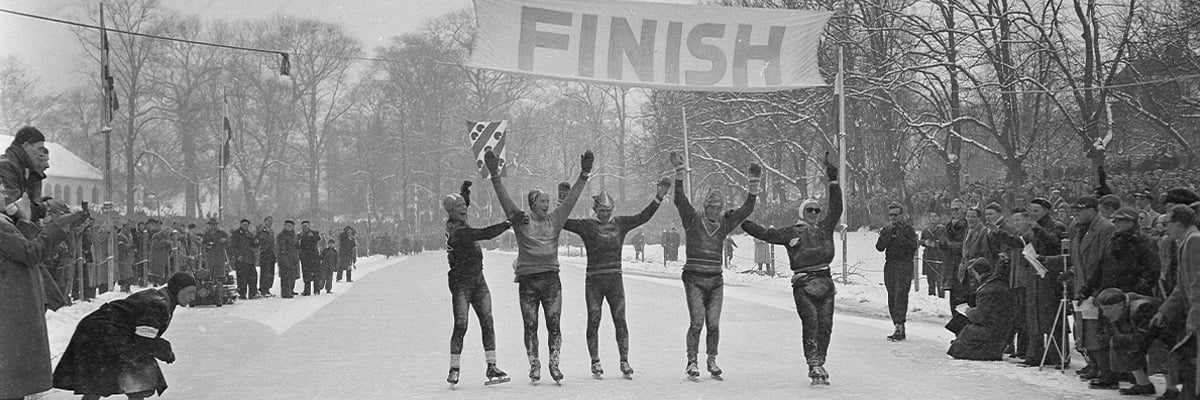
The Elfstedentocht is far more than an ice-skating race. It is a national symbol. A story of cold, perseverance, togetherness, and hope. Even people who have never put on skates know exactly what is meant when someone says: “It giet oan.”
In this blog, we take a deep dive into the history, meaning, route, myths, and the reason why the Elfstedentocht is still very much alive—despite the fact that it has not been held for decades.
What is the Elfstedentocht?
The Elfstedentocht is a nearly 200-kilometre ice-skating tour and race on natural ice in the province of Friesland. The route connects eleven historic Frisian cities via canals, lakes, and waterways. The event can only take place if the ice is thick and safe everywhere along the route. And that is exactly what makes it so special: it cannot be planned.
It is not an annual event. There is no fixed date. No guarantees. Sometimes it happens more than once within a few decades, sometimes not at all. This unpredictability has given the Elfstedentocht an almost mythical status.
Participation in the Elfstedentocht is limited. Only a fixed number of skaters are allowed to take part. To be eligible, skaters must register in advance and meet specific requirements. Recreational participants must be members of the Koninklijke Vereniging De Friesche Elf Steden and hold a valid skating licence. Registered participants receive an official start card, which is required to begin the tour and to collect stamps at each of the eleven cities along the route.
Because the event is so rare, many people have historically travelled to Friesland regardless. When the Elfstedentocht was announced, spectators and hopeful skaters would arrive in large numbers, some simply to experience the atmosphere, others in the hope that places might become available if registered participants withdrew.

At the sign up of the 14th edition of the Elfstedentocht, stood men with signs asking for registrations.
The eleven cities of the tour
The route traditionally passes through these eleven Frisian cities, in this order:
- Leeuwarden
- Sneek
- IJlst
- Sloten
- Stavoren
- Hindeloopen
- Workum
- Bolsward
- Harlingen
- Franeker
- Dokkum
Both the start and finish are in Leeuwarden, the beating heart of Friesland. While the exact route may vary slightly from one edition to another due to ice conditions, the cities themselves never change. That consistency makes the tour recognisable and timeless, despite the unpredictability of nature.

A tour of extremes distance and conditions
Skating nearly 200 kilometres on natural ice is demanding even under perfect conditions. During the Elfstedentocht, conditions are rarely perfect. Participants may face:
- strong headwinds
- snow on the ice
- cracks and rough surfaces
- extreme cold
- exhaustion and cramps
That is why the Elfstedentocht is not only a sporting challenge, but also a mental one. Anyone who reaches the finish has accomplished something extraordinary.


Not just for elite skaters
Although professional racers receive much of the media attention, the majority of participants are recreational skaters. Ordinary people who may have trained for months or even years, often with just one goal: to be able to say for the rest of their lives, “I skated the Elfstedentocht.”
The history of the Elfstedentocht
The beginning
The first official Elfstedentocht took place in 1909. It quickly became clear that this was no ordinary sporting event. The combination of nature, distance, and regional pride attracted massive attention. Friesland took centre stage, but the whole country watched.
Since then, the tour has only been held 15 times. That low number shows just how rare the right conditions truly are.
Legendary editions
Some editions are firmly etched into the collective memory:
1947 – Chaos, snowstorms, and extreme cold
1963 – The toughest edition ever, with only a handful of finishers
1985 & 1986 – Two tours in quick succession after a long absence
1997 – The most recent Elfstedentocht to date
Each edition has its own stories, heroes, and moments of hardship.
It giet oan
Three words that mean everything
Perhaps the most famous moment surrounding the Elfstedentocht is the announcement that it will go ahead. The words “It giet oan” (Frisian for “It’s on”) are legendary. They bring: nationwide excitement, spontaneous days off work, traffic jams heading towards Friesland, and a shared sense of euphoria
Even people who are not participating feel that something special is happening. The country changes, if only briefly. Life slows down. Everyone talks about the same thing.
The role of Friesland
The Elfstedentocht is deeply rooted in Frisian identity. It is not a commercial spectacle, but an event built on: volunteers, ice inspectors, stamp checkpoints, local involvement.
Thousands of Frisians dedicate themselves, unpaid and wholeheartedly, to making the tour possible. Without them, there would be no Elfstedentocht. That is why it is not an event in Friesland, but truly an event of Friesland.


Why it may never happen again
A difficult but realistic question: Will there ever be another Elfstedentocht?
Due to climate change, long and severe winters have become increasingly rare. Sustained periods of frost, day and night, without thawing, are no longer a given. The possibility still exists, but it is shrinking.
And yet, hope has never disappeared. Every winter, the ice is measured. Every cold spell sparks excitement. As long as that remains true, the Elfstedentocht lives on.
The Elfstedentocht as cultural heritage
Even without new editions, the Elfstedentocht continues to exist today through books, documentaries, school lessons, family stories and everyday expressions.
It is a story that is passed on from generation to generation. Not because it must be, but because it says something about who we are: practical, resilient, and stronger together.
More than sport
The Elfstedentocht is not just about winning. It is about:
- pushing personal limits
- dealing with adversity
- suffering together and celebrating together
- respect for nature
That is what makes it timeless. Even in a modern world driven by speed and technology, the Elfstedentocht remains an anchor point—a reminder of simplicity, cold, and character.


In conclusion
Maybe it will never happen again. Maybe it will happen tomorrow. No one knows. And that uncertainty is exactly what makes the Elfstedentocht so special. As long as water can freeze and people can dream, it will continue to exist.
Not as a fixed event on a calendar, but as an idea. A longing. A story that begins anew every winter.
 Beauty Products
 View all
 By Skintype
 Brands A-Z
 Wellness
 Health / Nutrition