
 SHOP




 Dutch Health Store Collection

 English
 Nederlands
 Deutsch
Votre Beaute,Lepaar
Lepaar skincare: ripened in the Australian sun
Nov
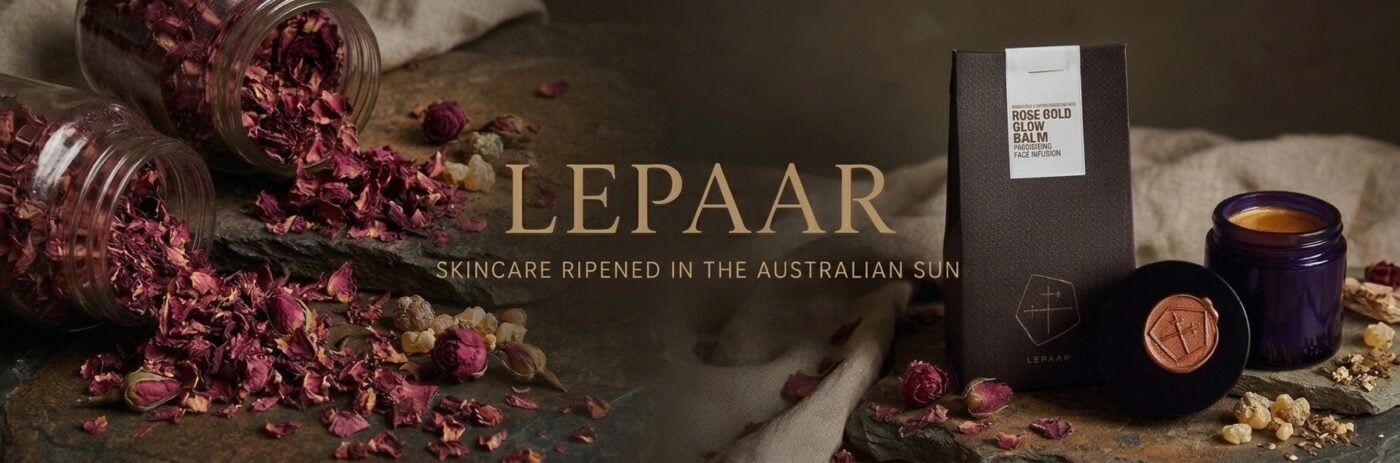
Lepaar: skincare ripened in the Australian sun
Some brands you simply buy. Others you get to know. Lepaar belongs firmly in the second group. Behind those violet glass jars there is no factory and no marketing department, just a couple living on a piece of land in a green valley on the east coast of Australia. There, Johanna and Christo Everingham leave flowers, peels, resins and seeds to ripen in olive oil under the sun for months on end, blend their formulas in rhythm with the moon and fill every bottle by hand.
In this blog, we take you to that valley. We tell the story of a woman who learned from her mother how to make a salve, of an Austrian philosopher who turned farming upside down a century ago, of a firestorm that nearly destroyed the harvest, and of a surprisingly Dutch detail in the packaging. And of course we put a few products in the spotlight, with the undisputed star being the Rose Gold Glow Balm.
A valley once called Parronrah
About two hours’ drive southwest of Sydney lies Kangaroo Valley. In the Dharawal language, the valley is called Parronrah. It is a wide, gently sloping valley along the Kangaroo River, enclosed on every side by high escarpments. Arrive early in the morning and you will see mist hanging over the pastures and rainforest that seems to pour down the steep rock walls. The village is also home to Australia’s last surviving wooden suspension bridge, the Hampden Bridge with its sandstone turrets.
Long before Europeans arrived, this was the home of the Wodi Wodi, a group within the wider Dharawal nation. According to tradition, they had lived here for some twenty thousand years when the British landed in 1788. They relied on the rivers, forests and escarpments for food, medicine and ceremony. In the nineteenth century the valley became farmland: around 1840, settler Henry Osborne began making butter here, which was carried in kegs on packhorses over the escarpment to Wollongong, bound for the markets of Sydney.
Lepaar takes that history seriously. On its website the brand acknowledges that it works on Dharawal country and recognises the Wodi Wodi as its traditional custodians. Johanna and Christo live and work on a property of around one hundred acres, surrounded by escarpments, dense rainforest and native bush. Their biodynamic gardens grow some of the very plants that later end up in your jar.
Johanna and Christo: a pair from two worlds
Lepaar has no board of directors. Johanna and Christo Everingham are the founders, the owners and the only two people running the business. They have been making their products in small batches since 2013.
Johanna grew up in the anthroposophical movement. Her parents and grandparents were deeply involved in it, and she herself went to a Steiner school. Her mother Ulla, who called herself an alchemist, taught her how to make natural cosmetics and home remedies. Johanna has now been making her own skincare for more than twenty years. She loves seeking out ingredients others overlook, experiments with old folk methods and keeps refining a formula until, in her own words, it starts to “sing”.
Christo comes from a completely different angle. His passion is culture, from the basic to the refined: tribal art and furniture, European fabric houses, theatre and dance. Around the age of twenty he was inspired by Yvon Chouinard, the founder of Patagonia, and taught himself to sew so he could make his own tents, backpacks and bags. That skill came in handy later on: the very first Lepaar products came in outer packaging he stitched by hand.
To Dutch ears the name sounds almost like “het paar”, the pair. Whether that is intentional, the brand does not say, but it fits: an earlier version of their story described the two of them as a pairing of spirits, with different backgrounds but the same values. Their motto is just as spirited: “If you don’t have a sword in your nature, you can’t hold your line.”
A fun fact: Lepaar has made more than skincare. The couple also designed simple accessories made to be repaired rather than thrown away, and even sustainable luxury garden hoses built to last a lifetime, so less ends up in landfill. That says a lot about how they look at the things we own.
An idea from 1924: Steiner and biodynamic farming
To understand Lepaar, you need to go back to Europe in 1924. That year the Austrian philosopher Rudolf Steiner, founder of anthroposophy, gave a series of lectures to farmers worried about their exhausted soils. Biodynamic agriculture grew out of those lectures. Australia’s Biodynamic Association describes it as a way of farming that brings science together with a recognition of spirit in nature.
In practice that means seeing the farm as one living organism, feeding the soil with fermented preparations made from manure, plants and minerals, and timing sowing and harvesting by a calendar that follows the moon and the stars. Those who meet the strictest standards may carry the Demeter certification. You may know it from wine: some of the most famous wine estates in the world farm biodynamically. The movement has deep roots in Australia too; Tasmania recently held a three day celebration marking one hundred years of biodynamics in Australia and New Zealand.
To be fair, not everyone is convinced. Sceptics argue that the preparations themselves have no measurable effect, and that biodynamic farmers get better results mainly because they pay far more attention to their land. But that very attention is what Lepaar is all about. The brand draws on the anthroposophical idea that a human being is made of body, soul and spirit, and aims to nourish all three. The base of nearly every product is Australian olive oil: cold pressed, extra virgin, unrefined and Demeter certified. And the formulas are blended around the full moon and the new moon.
Patience as an ingredient: the art of sun infusion
Most cosmetics are made with heat, solvents or high pressure. Lepaar chooses the opposite: time. In sun infusion, dried flowers, fruits, peels, leaves, bark, seeds, resins and sometimes even wood and minerals go into glass jars of biodynamic olive oil. The jars are then left in the sun. Slowly, through gentle and steady warmth, the plants release their active compounds, colour and scent into the oil. This usually takes four to six months, and for a particularly precious batch sometimes up to a year. Just like a winemaker, the brand calls such a batch a vintage.
A few examples show how far that dedication goes. Stinging nettle, with its leaves, stems and roots, infuses for six to nine months so that the heat sensitive ursolic acid stays intact. For the Luxurious Body Firming Oil every orange is peeled by hand, after which the dried peel spends half a year infusing in the sun. And then there is the rose. Five millilitres of distilled rose oil requires around 242,000 petals. Lepaar instead infuses rose petals for three months in direct sunlight. The result is a rich, almost waxy oil with a scent the brand itself calls heavenly.
Behind the method lies a belief. Johanna believes plants still carry a life force after harvest, and that dried plants are concentrated holders of healing properties, waiting to be “awakened” in her extracts. Early on she moved from single plant extracts to infusing several plants together in one jar. According to her, that changed everything: the action became stronger, the scent richer, and the whole became greater than the sum of its parts.
What stays out is just as telling. Lepaar uses no nut oils, no CO2 extracts and no absolutes, nor any artificial preservatives, stabilisers or fragrances. The brand picks ingredients so naturally rich in antioxidants that preservation is not needed. Certification is preferred, but for exceptional harvests from small growers who share its values, the brand will sometimes deliberately forgo the label. The beeswax, for example, comes unrefined and unbleached from beekeeper friends in the Blue Mountains, and Lepaar works with local food, coffee and natural wine producers to give their plant leftovers a second life.
Frankincense, myrrh and gold: the Sacred Trinity
Frankincense, myrrh and gold: the three gifts the wise men from the East brought to Bethlehem, according to the Gospel. For centuries they were among the most precious substances known to humankind. Frankincense and myrrh are resins that seep from the bark of trees in the dry lands around the Arabian Sea, and since antiquity they have travelled along caravan routes as medicine, offering and perfume.
At Lepaar this trio returns in almost every product, under the name Sacred Trinity Charge. The frankincense comes from Somalia and Oman, including the prized Royal Hojari. The myrrh comes from Somalia and from Namibia, home of the remarkable Omumbiri myrrh. Both resins are sun infused in olive oil and also used in tiny amounts as steam distilled essence. The gold is 24 karat, cosmetic certified and non nano. It comes from a German family company which, according to Lepaar, is the world’s only certified supplier of cosmetic gold, and that gold too spends at least four months infusing in the sun.
According to the brand, this combination brings body, soul and spirit into balance and supports ageing gracefully. Whether you take that literally or mostly symbolically, it gives every jar something ceremonial, as if each time you apply it you carry on a very old ritual.
When the fire came
When you work with nature, you are also at its mercy. Kangaroo Valley learned that in the summer of 2019 into 2020, the season Australians now call the Black Summer. The Currowan fire started on 26 November 2019, more than one hundred kilometres south of the valley. For weeks residents watched the smoke draw closer. On the afternoon of 4 January 2020 the fire front reached the valley, on a day when nearby Nowra hit more than 43°C and winds blew at over 55 km/h.
The fire destroyed around fifty homes in Kangaroo Valley, about ten percent of all houses. In the end it burned for 74 days across more than 320,000 hectares. Research by the University of Wollongong describes how the small community organised itself beforehand and helped each other back on their feet afterwards.
Lepaar felt the blow too. On their brand page at the time, Johanna and Christo wrote that the summer harvest had taken a big hit after the fires and that some products were running low as a result. They thanked their customers for their understanding and signed off with a line that sums up their character: “Sunshine sings + Moonlight dances!” It shows what it means when a brand is truly tied to a place. There is no factory that just keeps running; when the land suffers, you notice it in the jars.
A Dutch secret in your bathroom
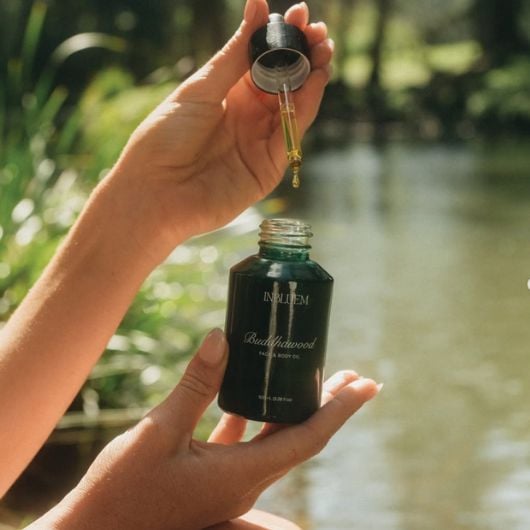
Pick up a jar of Lepaar and the first thing you notice is the deep, almost black violet of the glass. That is not a design choice but protection. Lepaar packs its products in patented Miron glass, sealed with a hand applied seal of 100% natural resin wax.
And here comes the surprising part for us: Miron is a Dutch company. The violet glass was developed in Switzerland in 1995. Four years later it came to the attention of the De Boer family, because Evert de Boer was looking for something that could help his mother Eelkje with her health. Today Miron Violetglass has its headquarters in Hoogeveen, in the Dutch province of Drenthe, and supplies brands all over the world. So products made with such patience in the Australian sun are protected by glass with roots in Drenthe.
How does it work? Ordinary clear glass lets almost all light through. Brown glass filters more broadly, but still not everything. According to the manufacturer, Miron glass blocks the entire visible light spectrum except violet, while letting UVA and infrared through. Visible light speeds up the breakdown of natural substances, which is exactly what you do not want in a product without preservatives. Miron supports this with its own storage tests. For a brand that wants to preserve the life force of plants, it is a logical choice in any case.
Spotlight: the Rose Gold Glow Balm
If there is one product that captures the entire Lepaar philosophy in a single jar, it is the Rose Gold Glow Balm. The idea behind it is as simple as it is clever: a balm built entirely around the rose family, yet one that does not smell of roses.
That sounds contradictory, until you realise that the rose family, botanically the Rosaceae, is much larger than the rose alone. Apple, plum, strawberry, sloe, peach, apricot, cloudberry and loquat all belong to it. Johanna built the balm from the seed oils and extracts of exactly these relatives. The brand calls the result the rose gold of the late summer sun: the warm, golden glow of a late August afternoon, captured in a jar.
A journey through Europe and beyond
The ingredient list reads like a travel diary. Plum kernel oil and peach kernel oil from Austria. Apple seed oil and strawberry seed oil from Poland. Sloe oil from Germany. Oil from the cloudberry, an orange berry from the Nordic bogs, from Norway. Apricot kernel oil, vanilla, loquat leaf and hibiscus from Australia. An extract of the cabbage rose, also known as the May rose, from Germany, France and Australia. Peony root and a plant wax from the Japanese sumac from Japan. Australian beeswax, evening primrose oil and of course the biodynamic olive oil as the base.
On top of that come a few special ingredients that complete the story:
Chaga. This mushroom grows on birch trees in cold northern forests and looks like a lump of charred wood. Lepaar uses chaga to support the skin with antioxidants and for elasticity.
Tremella. This white, jelly like mushroom is also known as the snow mushroom. According to legend, it was a beauty secret at the Chinese imperial court. In the balm it provides hydration.
Peony. The root and leaf extract has been added to calm easily irritated skin.
Dragon’s blood. A deep red resin that Lepaar sources from Socotra, a remote island belonging to Yemen, famous for its otherworldly landscapes.
24 karat gold. The golden thread running through every Lepaar product. According to the brand, the gold captures the energy of the sun and anchors the intentions with which the balm was made.
How does it feel and smell?
The Rose Gold Glow Balm is almost translucent, light and non occlusive. It absorbs quickly and leaves no greasy film, which is not what you would expect from a balm. It contains no essential oils, no preservatives and no artificial colours, which also makes it interesting for anyone sensitive to fragrance.
The scent is subtle and delicious: sweet apple, summer berries, a soft marzipan like note from the kernels of peach, plum and apricot, a hint of rose petals and, far in the background, something earthy from the mushrooms. It feels more like an autumn orchard than a perfumery.
Who is it for?
Lepaar says the balm suits all skin types, but especially mature, dry, dull and sensitive skin. One customer with dry, ageing skin wrote that the balm absorbs quickly without feeling greasy, gives a beautiful glow and smells divine. That is exactly the promise: a radiance that does not come from glitter on the skin, but seems to shine from within.
How to use it
Every morning take a small amount, Lepaar itself speaks of “a smear”, and gently massage it over face and neck. Our tip: warm the balm between your fingertips first and press it onto skin that is still slightly damp, for example after a few spritzes of a Lepaar mineral water. That way it spreads even more beautifully. On days when you want extra glow, dab a little more onto your cheekbones.
If you love the rose theme, pair the balm with two other products with which Lepaar once told three different rose stories: the Glow White Rose Sandalwood Mineral Water, with Bulgarian white rose and Australian sandalwood, and the Rosa Aurea Perfume Oil, a perfume oil with rose, sandalwood and oud.
The Rose Gold Glow Balm (30 ml) is available at Dutch Health Store for €99.
More from Johanna’s apothecary
The Rose Gold Glow Balm does not stand alone. Here are a few other Lepaar products, each with a story of its own:
Precious Face Elixir
This is the brand’s all round face oil, designed to bring any skin into balance, whatever its age or concern. A leading role goes to sea buckthorn from northern Germany, an orange berry that grows on sandy soil and is rich in the rare omega 7. Johanna recently added new season pomegranate peel and seed, locally grown organically and wild harvested. Available in 15 and 30 ml, from €57.
Zen Matcha Cashmere Reforming Night Serum
A night serum in which stinging nettle is the star. Leaves, stems and roots infuse for six to nine months in biodynamic olive oil. Nettle may well be the most underrated herb there is: the plant you avoided as a child turns out to be a treasure trove. Price €99.
Luminous Beauty Balm
A soft, deeply hydrating recovery balm originally made for skin that has been through a lot, for example after a day in sun and wind. It contains Bulgarian damask rose, Namibian myrrh, chamomile and wild carrot, among others. Price €99.
Golden Age Honey Mask
A mask based on raw, wild honey from the Blue Mountains, made by the bees of Tim Malfroy, a beekeeper known for his natural approach to keeping bees in Warré hives. The enzymes in the honey provide gentle exfoliation. Johanna herself says it is a mask that would make Cleopatra proud. Price €62.
Night Milk Honey Mask
Perhaps the most Australian product of them all. It contains camel milk from sustainable farms in the Outback. Camels are not native Australians: they were brought over in the nineteenth century as pack animals for desert expeditions, and today a large wild population roams the interior. Camel milk has been used in skincare for centuries; in the Arab world it was long seen as a secret against the scorching desert sun. Price €59.95.
Luxurious Body Firming Oil
The body oil with the hand peeled oranges we mentioned earlier. Half a year of sun infusion, combined with neroli. According to Lepaar, orange works not only on the skin but also on the mood: uplifting and calming at the same time. From €62.95.
Ritual: making Lepaar part of your day
Lepaar is made to be used slowly. A few habits the brand itself recommends, and a few we are happy to pass on:
Start with a mist of one of the mineral waters, which are best kept in the fridge. On that slightly damp skin, apply a few drops of Precious Face Elixir, followed by a little balm, such as the Rose Gold Glow Balm. Use your ring fingers for this: they have the lightest touch of all your fingers and pull least on the skin.
Take your time. Breathe in the scent before you begin and massage with calm movements. That is not an afterthought but exactly the point: at Lepaar, care is as much about your nervous system as about your skin.
And then a tip you cannot buy in a jar. Johanna recommends now and then taking a walk in the rain with nothing on your face, to replenish skin and soul. Here in the Netherlands, luckily, you rarely have to wait long for the chance.
Final thoughts
In a world where skincare keeps getting faster, more technical and harsher, Lepaar is a conscious slowing down. A brand of two people, on Dharawal country, who wait months for the sun to do its work. Who are guided by a hundred year old farming philosophy and by the lessons of a mother. Who survived a fire and then simply went back to picking, drying and waiting.
You can feel that patient approach in every product, and perhaps most of all in the Rose Gold Glow Balm: an orchard full of rose relatives, gathered from across Europe, ripened in the Australian sun and kept in glass from Drenthe.
Curious? You will find the complete Lepaar collection, including the Rose Gold Glow Balm, in our webshop.
The descriptions of effects and energetic properties in this blog are based on information from Lepaar itself and are not intended as medical advice.
 Produits de beauté
 Marques A-Z
 Bien-être
 santé et nutrition