
 SHOP











 Dutch Health Store Collectie

 English
 Deutsch
 Français
Beauty Tips, Gids & Informatie, Vivo Red Light, Wilma
Red Light Therapy from A to Z, Part 1: What happens inside your cells?
okt
Wilma Explains:
Red Light Therapy from A to Z Part 1: What happens inside your cells?
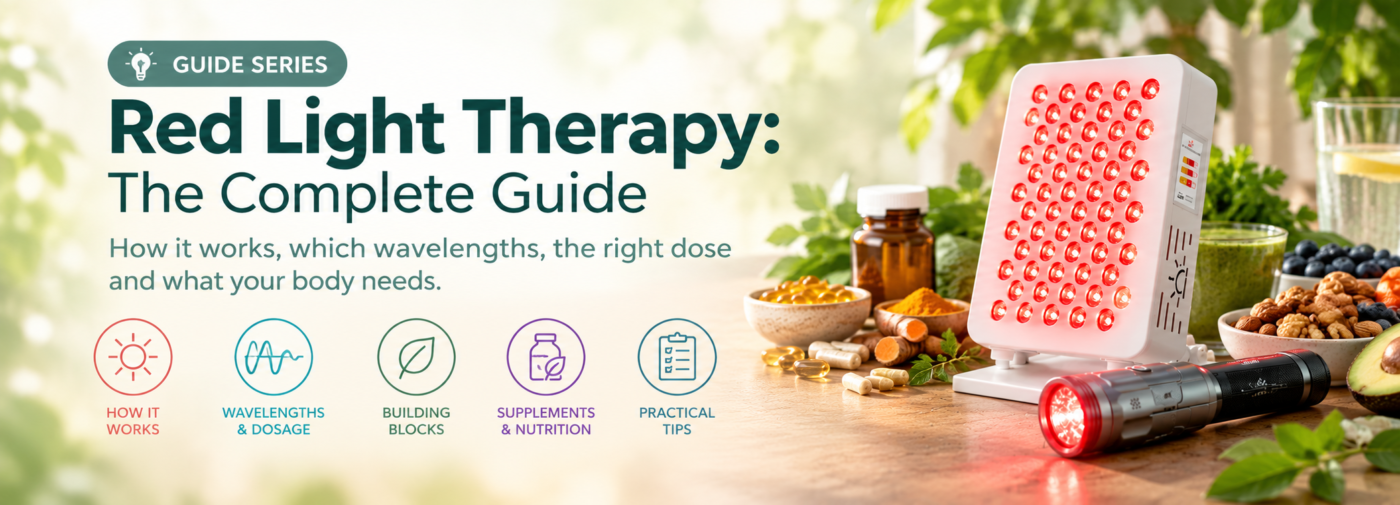
Red light therapy has grown in recent years from a tip for athletes and biohackers into something more and more people use at home. For pain, for the skin, for sleep, for energy. At the same time, the confusion is growing too. What is proven? What is promising? And what is mostly marketing?
In this series of four parts we put everything in order. We combine what we have written recently about treatment spots, sleep, mood, blood sugar, the thyroid, the mouth and the immune system with additional scientific research. And because light only works well when your body has the right building blocks, we add naturopathic and orthomolecular advice to every part.
What you will read in this series
- Part 1: how red light works, wavelengths, dosage and the building blocks of your mitochondria.
- Part 2: head, eyes and sleep, with attention to mood, the winter blues and blood sugar.
- Part 3: pain, muscles, skin, mouth and thyroid.
- Part 4: gut, immune system, hormones and your personal routine in practice.
We are honest about the quality of the evidence. Sometimes there is solid research with several controlled studies. Sometimes the studies are small but promising. And sometimes it is mostly laboratory research. You will always read which of the three it is.
What is red light therapy?
In science it is called photobiomodulation, or PBM for short. You expose the body to low dose red light and near infrared light. This light is not harmful and does not damage tissue, the way UV light can. It is also not meant to heat the body. The goal is to give cells a signal.
Visible red light (around 630 to 670 nm) penetrates a few millimetres to several centimetres into the tissue. Near infrared light (around 810 to 850 nm) is invisible and goes deeper, into muscles, joints and sometimes even further. That difference determines which wavelength you use for which purpose.
How does it work? What we know and what is still being studied
The most common explanation involves the mitochondria, the energy factories of your cells. They contain an enzyme, cytochrome c oxidase, that can absorb red and near infrared light. 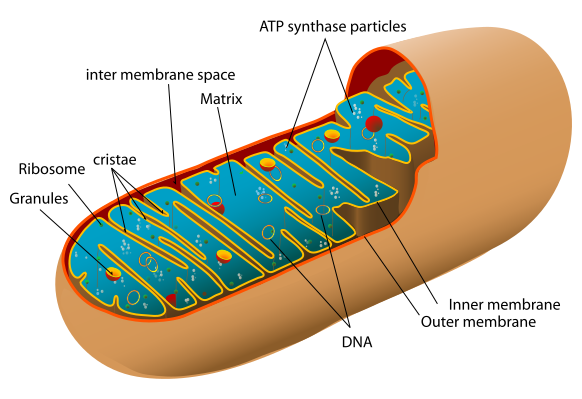 This enzyme is an important link in the production of ATP, the fuel of the cell. When light stimulates the enzyme, the cell can make more energy. Cells with more energy recover better, divide better and communicate better.
A second mechanism involves nitric oxide. This molecule, which your body makes itself, can attach to the same enzyme and slow down energy production, for example during stress, inflammation or a lack of oxygen. Light can release that molecule. As a result, cellular respiration can get going again and blood vessels widen, which improves circulation.
In addition, researchers at the American National Institute on Aging described two other routes in 2023. There are light sensitive proteins in the cell membrane, such as ion channels and receptors, that respond to light. And there is a signalling molecule called TGF beta 1, which plays a role in tissue repair.
To be honest. The exact mechanism has not been fully clarified yet. In 2020, Quirk and Whelan found no clear effect of light on cytochrome c oxidase in laboratory experiments with isolated enzymes, and they point to the role of nitric oxide. The idea that light supports energy production fits many observations, but it has not been confirmed in every experiment. That is no reason to dismiss the therapy. It is a reason to be careful with big promises.
Which wavelengths work?
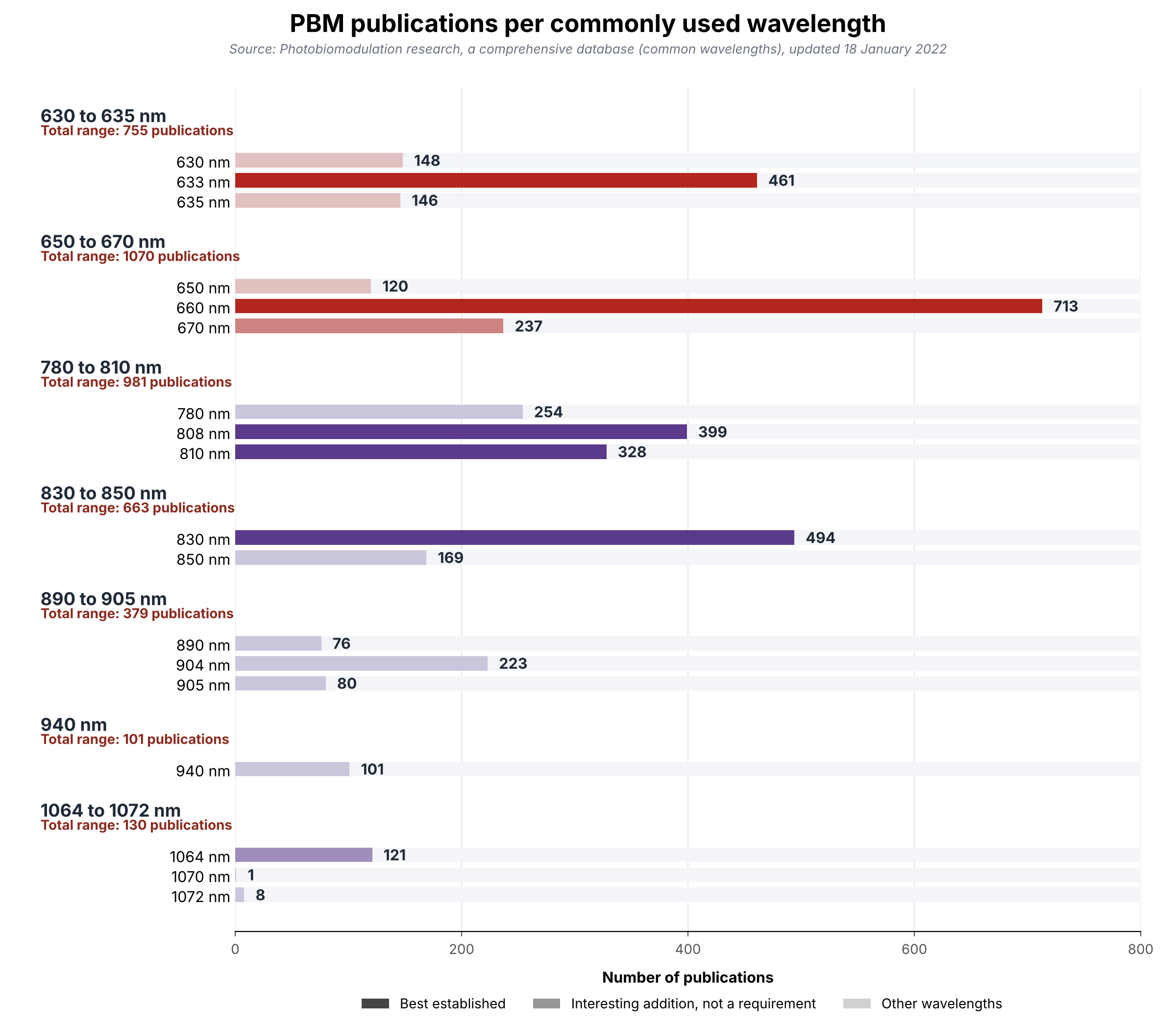 In research, the same wavelengths come up again and again.
- Red light: 630, 660 and 670 nm. Mainly suited for skin, mucous membranes, eyes and wounds.
- Near infrared light: 810, 830 and 850 nm. Deeper tissue, such as muscles, joints, thyroid, abdomen and brain.
- The zone between 700 and 780 nm turns out to be barely effective, because the enzyme hardly absorbs light there.
In studies on oral health, red light is often given at 630 or 660 nm and near infrared light at 810 or 830 nm. Combining several wavelengths seems to work better in much of the research than a single wavelength alone. That is why good devices usually contain a mix of red and near infrared.
Dosage: more is not better
The dose is the amount of light energy that ends up in the tissue. You calculate it by multiplying the intensity (in mW/cm²) by the time. The result is a dose in joules per square centimetre (J/cm²).
An example from our own blogs: a study on the effect of light on the back used only 9.18 mW/cm² at a distance of 50 cm. After 15 minutes that comes to 8.26 J/cm². A remarkably low dose that still had an effect.
That low dose is no coincidence. In photobiomodulation you see what is called a biphasic dose response. This means that a low to moderate dose has an effect, but that at a certain point more light gives less, or even flattens the effect. This was already described by Huang and colleagues in 2009 and returns in almost every review.
As a guideline, the literature shows:
- 1 to 10 J/cm² for superficial tissues, such as skin, mucous membranes and eyes.
- 10 to 50 J/cm² for deeper tissues and pain relief.
For your own device, that means a treatment time that depends on the device and the distance. For the BioPhoton 3.0, for example, the manual gives for superficial applications at a distance of 15 cm a time of about 3 minutes (minimum) to 23 minutes (maximum), with around 13 minutes as the optimum. For deep tissue with skin contact it is between 15 and 50 minutes. Always check the manual or the dosage tool of your own device, because every device is different.
An important lesson from the brain studies: dose works in two directions. In a controlled study on transcranial photobiomodulation for depression, researchers found no difference from placebo, because the dose was too low. The researchers concluded that there is probably a minimum threshold. Too little light simply does nothing. We come back to this in part 2.
Skin contact or at a distance?
With the skin contact method you place the device directly on the skin. Less light is then lost to the air and to reflection. With light pressure the light can also penetrate deeper, because the blood is briefly pushed out of the tissue. This is especially useful for deeper structures, such as the kidneys, the intestines, the jaw joint or the thyroid.
Working at a distance is better for larger surfaces, for the skin and for general routines. A large panel is more practical then. A small device such as the BioPhoton 3.0, the BioPhoton+ and the Torch 2.0 gives you more control to treat specific spots.
The systemic effect: treating locally, with a broader effect
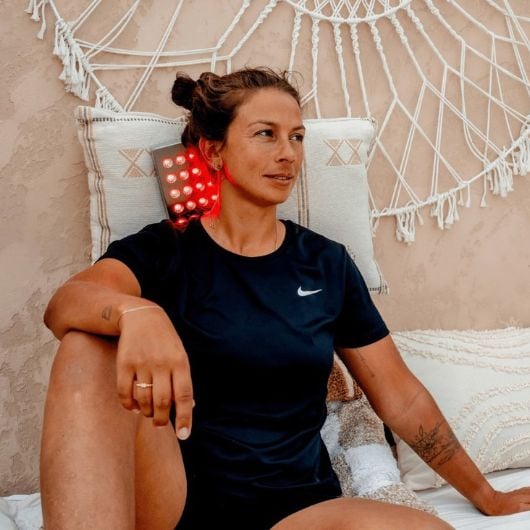 Many people wonder whether you really need to aim the light at the problem area. That often helps, but the effect does not always stay limited to that spot. In a study on wounds, not only the treated wounds healed faster, but also untreated wounds elsewhere on the body. Researchers call this the abscopal effect, or the systemic effect.
How is that possible? Light activates mitochondria in the skin, muscles and blood. This releases signalling molecules, such as cytokines, which can bring cells elsewhere in the body into a healthier state. Nitric oxide, circulation and immune cells also play a role. A recent study even showed that light on the back had an effect on the eyes. And in a 2024 trial by Powner and Jeffery, exposing the upper back had an effect on blood sugar (see part 2).
In part 4 we discuss the 11 strategic treatment spots you can use to make targeted use of the systemic effect.
What should you look for when choosing a device?
Look at more than the number of LEDs or the number of watts. A 2026 review by Spongberg and colleagues showed that the supply of consumer devices is growing faster than the guidelines. So pay attention to the following points.
- The right wavelengths, demonstrably measured.
- A measured light intensity at the distance at which you use the device.
- Tested for flicker. Flickering light can cause headaches, eye strain and migraine in sensitive people.
- Low and measured EMF values.
- A clear dosage guideline per application.
Naturopathic and orthomolecular: building blocks for your mitochondria
Light is a signal, but your cells also need material to turn that signal into energy. A car with a full tank and an empty battery will not start either. From naturopathic and orthomolecular medicine, these are the most important building blocks for your energy metabolism.
Coenzyme Q10. This is part of the respiratory chain of the mitochondria, the same chain the light acts on. A meta analysis of 13 controlled studies with more than 1,100 participants in total found that Q10 can reduce fatigue. The effect was largest with Q10 as the only supplement, with a higher dose and with a longer period of use (4 to 24 weeks). However, the participants had conditions that cause fatigue. In healthy people the evidence is weaker.
Magnesium. Needed for the production of ATP and for almost every energy consuming reaction in your body. Magnesium is used up faster during stressful periods.
B vitamins. Especially B2, B3 and B12 are involved in energy metabolism. B12 is more often too low in people who eat few animal products and in older adults.
L carnitine and alpha lipoic acid. They help transport fatty acids to the mitochondria and support energy metabolism. The evidence for healthy people is limited.
Iron. Cytochromes contain iron, and with a low ferritin level you often notice it as tiredness. Have this measured first, because too much iron is harmful too.
 The basics that are often forgotten. Enough protein, good sleep, exercise and daylight are at least as important as any supplement.
Practical advice
- If you have long lasting complaints, first have your levels checked, for example ferritin, vitamin D, B12 and magnesium. There is no need to guess with supplements.
- Build up supplements one at a time, so you can see what your body responds to.
- Do you take medication? Then always consult your GP or pharmacist, because supplements can interact with medication.
Sources
- Hamblin MR. Mechanisms and applications of the anti inflammatory effects of photobiomodulation. AIMS Biophysics, 2017. Overview of the mechanism of action.
- Quirk BJ, Whelan HT. What lies at the heart of photobiomodulation: light, cytochrome c oxidase, and nitric oxide. Photobiomodulation, Photomedicine, and Laser Surgery, 2020.
- Huang YY et al. Biphasic dose response in low level light therapy. Dose Response, 2009.
- Workshop of the National Institute on Aging on photobiomodulation, report published in 2025 (PMC12181550).
- Iosifescu DV et al. Very low level transcranial photobiomodulation for major depressive disorder: the ELATED 3 trial. Journal of Clinical Psychiatry, 2022.
- Powner MB, Jeffery G. Light stimulation of mitochondria reduces blood glucose levels. Journal of Biophotonics, 2024.
- Tsai IC et al. Effectiveness of coenzyme Q10 supplementation for reducing fatigue: a systematic review and meta analysis of randomized controlled trials. Frontiers in Pharmacology, 2022.
- Spongberg CV et al. What to look for in red light therapy: a product guide backed by science. Cureus, 2026.
Disclaimer
The information in this blog is intended as general information and does not replace medical advice, diagnosis or treatment. Red light therapy and supplements are complementary and not intended as a replacement for regular care. If you have a serious condition or use medication, always consult your GP or treating specialist.
Continue with part 2: how light affects your eyes, brain, sleep and blood sugar, and which nutrients go with it.
Take care of yourself!
With love,
Wilma
 Beauty Producten
 Merken van A-Z
 Welzijn
 Gezondheid / Voeding