
 SHOP
SHOP





 Dutch Health Store Kollektion
 English
 Nederlands
 Français
Beauty Tipps, Leitfaden & Informationen, Vivo Rotlicht, Wilma
Elementor #392116
Sep.
Wilma Explains:
LED face masks: smart investment or just hype?
Red light has become hugely popular in recent years, and the LED face mask is probably the best known example. At Dutch Health Store we get questions about it every week. Does it really work? Is it safe? And is a mask the best way to use red light for your skin?
Because I want to answer those questions properly, this blog takes an in depth look at how red light works, the science behind it, the criteria that matter and the results of a practical test with a premium LED mask. I’ll also share practical tips on use, safety and choosing the right device. No marketing talk, just an honest story.
Red light works, but differently than you might think
Let me start with this: red light works. Not as a miracle cure, but as a proven tool that supports your body in recovery, skin health and relaxation. People who use it regularly and consciously really notice the difference.
It’s also no longer a niche for elite athletes or biohackers. More and more people are adding red light to their daily routine, simply at home, and with great results.
From clinic to living room
Red light used to be found mainly in clinics, beauty salons and physiotherapy practices. Gradually it has moved into people’s homes. First through large panels, later through increasingly compact and accessible devices.
That shift has made red light available to far more people. LED masks have played a big part in this. They are recognisable, easy to use and need little explanation. Thanks to countless social media posts and influencer collaborations, they became completely normal in a very short time. For many people, a mask is now the image of red light therapy.
And to be fair, that’s basically a good thing. The LED mask hype has literally brought red light into people’s homes. It has sparked curiosity and started the conversation about light and health.
Why red light can work so well
Red light doesn’t work because it’s popular, but because there’s a biological explanation for it. Our bodies respond to light, they always have. Specific wavelengths of red and near infrared light have a particular and well researched effect. In science, this process is called photobiomodulation.
When this light reaches your skin, it penetrates into the underlying tissue. There it is absorbed by the mitochondria, the power plants of your cells. A key enzyme in this process is cytochrome c oxidase. When that enzyme absorbs light, cells can produce energy (ATP) more efficiently. More energy means cells can do their job better, such as repairing and producing new building blocks.
In the skin, this mainly involves:
Better circulation, so oxygen and nutrients reach the skin cells more easily.
Reduced inflammation, which can help with redness and restless skin.
Support for collagen production, important for firmness and elasticity.
So red light isn’t magic, but a stimulus that helps your body do what it can already do naturally.
What does the research say?
A lot of research has now been done on red light and the skin. A well known example is a controlled study by Wunsch and Matuschka from 2014. Participants received treatments with red and near infrared light over a number of weeks. The researchers saw an improvement in skin texture, fewer fine lines and an increase in collagen density, measured by ultrasound. A review by Avci and colleagues from 2013 also describes the possible applications of light therapy for skin ageing, wound healing and acne.
Important to know: most studies use panels or lamps at a fixed distance, with a carefully controlled dose. That becomes relevant when we look at masks.
Not a quick fix
One thing I want to set straight right away: red light is not a quick fix. You may feel relaxed immediately after a session, but after three sessions you won’t suddenly have completely different skin. The effect is subtle and cumulative. You give your body the same light stimulus again and again, supporting processes over a longer period.
Realistically, most people notice the first changes after four to six weeks, such as a fresher complexion or more even skin. For effects on fine lines and firmness, it’s better to count on eight to twelve weeks of regular use. That takes consistency.
More light is not better
This is where things often go wrong in practice. Many people focus mainly on power and intensity. The stronger, the better, they think. But with red light, consistency is almost always more important than brute force. 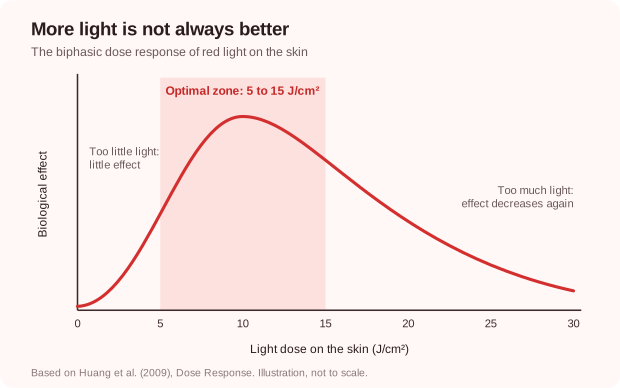 A well balanced stimulus that you can easily keep up delivers more than an occasional extreme session.
This principle is well known from scientific research and is called the biphasic dose response. Huang and colleagues, among others, described it in detail in 2009. Simply put: both too little and too much light produce little to no effect. There is an ideal middle zone. So the best results don’t come from the highest intensity, but from the right dose applied consistently.
How to calculate the dose
Useful to know: you can easily calculate the light dose yourself. The formula is:
Dose (J/cm²) = intensity (mW/cm²) × time (seconds) ÷ 1000
An example: a device that delivers 20 mW/cm² to your skin gives a dose of 6 J/cm² in 5 minutes (300 seconds). That falls right within the ideal zone for the skin. But note: this only works if you know how much light actually reaches your skin. And with many devices, that’s exactly the problem.
Does an LED mask work?
Short answer: yes, an LED mask with red light can work. There’s no need to make it more complicated than it is.
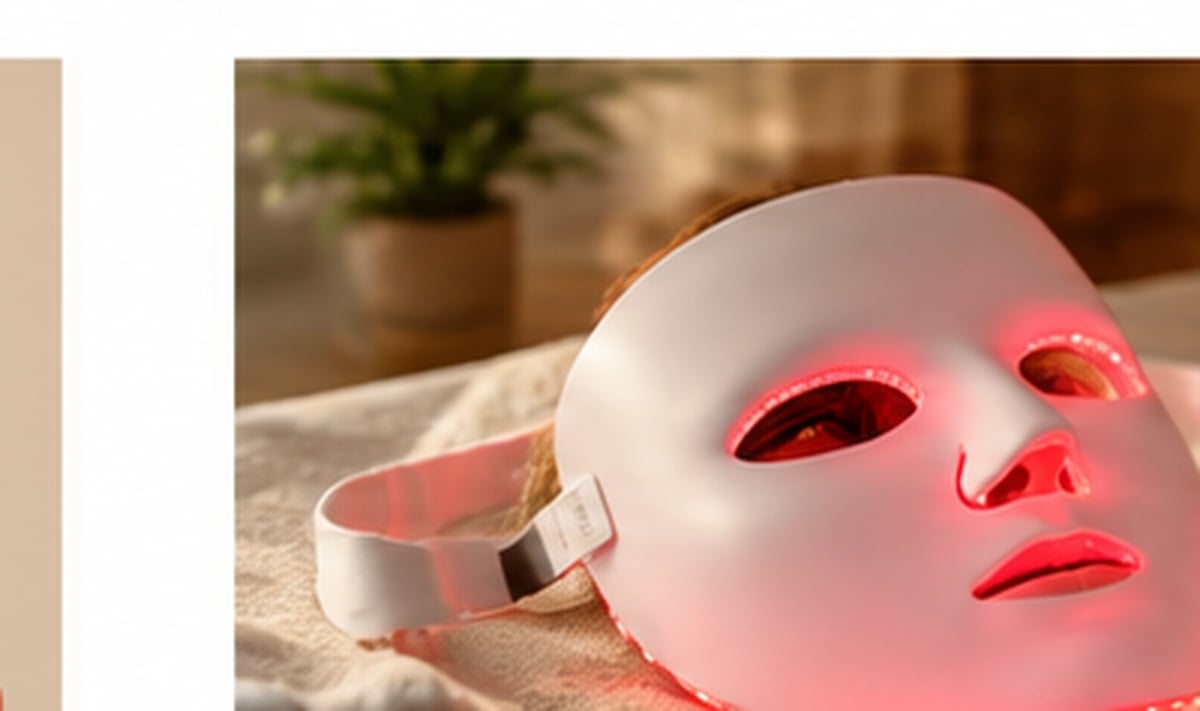 For many people, a mask feels simple. Put it on, wait a few minutes and you’re done. No fiddling with distance, settings or setup. It fits easily into your daily routine, which makes it easy for many people to stick with.
That’s exactly the strength of a mask. It lowers the threshold and makes red light accessible. For some people, it’s even the very first step towards light therapy.
But then come the questions that, in my opinion, are asked far too rarely:
Is a mask also the best therapeutic choice for your skin?
Are there downsides to this way of applying light?
And could you achieve the same or even better results with the same wavelengths in another way?
To answer that honestly, you need to look at the factors that determine whether red light is really being used optimally.
Seven criteria for a good red light skin treatment
To judge whether a device has real therapeutic value, I don’t look at the design or the packaging. I look at what your skin actually receives, and how predictable and safe that is with long term use. These are the seven points that make the difference for me.
1. The right wavelengths
For the skin, it’s mainly about red light, particularly between roughly 630 and 670 nanometres. That’s where the most scientific evidence lies for skin support, circulation and collagen. Near infrared light between 810 and 850 nanometres is a great addition for the deeper skin layers.
2. An effective dose
It’s not about wattage or the number of LEDs, but about how much energy actually reaches your skin. This dose is measured in joules per square centimetre (J/cm²). For the skin, the ideal zone is roughly between 5 and 15 J/cm², and you want to stay there consistently. Too little does little, and so does too much.
3. Even light distribution
You want to illuminate your skin as evenly as possible. An LED mask, however, always works with separate points of light just above or on the skin.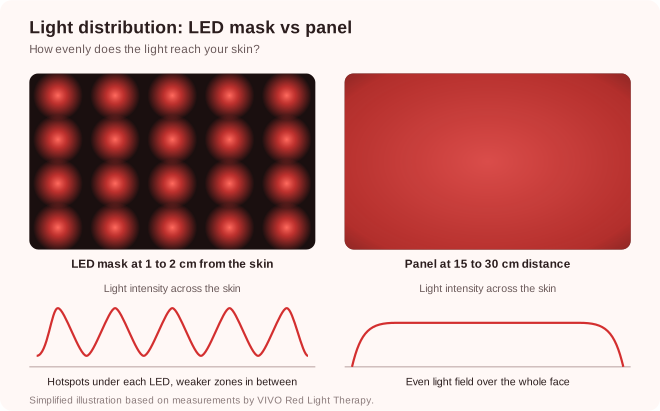 This creates hotspots directly under the LEDs, with weaker zones in between. For the skin that’s a limitation, because an even light field matters more than high intensity in one spot.
4. Skin contact, yes or no
This is often a source of confusion. Skin contact can be very valuable, but not for everything. If you want the light to penetrate extra deep, for example for muscles, joints, tendons or organs, direct contact is ideal. For the skin itself you want something else: you want the light to work on the skin, broadly and evenly distributed.
5. Temperature and comfort
Red light works through a photochemical process, not through heat. Heat is therefore not a goal. With devices that sit directly on your face, such as a mask, limited ventilation and prolonged contact can still make it warm. That can cause irritation or unwanted skin reactions.
6. Electromagnetic fields (EMF)
This point is often underestimated. Many devices carry a CE mark, but that only says something about electrical safety. It says nothing about electromagnetic fields. With a mask, the electronics sit directly against your head, around your forehead and eyes. EMF values are rarely measured properly or shared openly.
7. Fit and application
A device can be technically excellent, but if it’s uncomfortable, you won’t use it. LED masks sit tightly on your head and don’t fit everyone equally well. Pressure points on the forehead, nose or around the eyes are common and vary by face shape. On top of that, the application is limited, as a mask can only be used for your face.
An LED mask tested in practice
One of the most thorough practical tests I’ve come across was carried out by VIVO Red Light Therapy, a Dutch specialist in red and near infrared panels. Years ago they already tested several early LED masks. Those models stood out mainly for high EMF values, poor wearing comfort and uneven light distribution.
Much has changed since then. The range has grown enormously, the masks look better and the claims sound more professional. Because technology keeps evolving, VIVO Red Light Therapy tested a mask once again. They deliberately chose a premium model that is still rarely sold in the Netherlands, so the test wouldn’t directly harm anyone. Below I’ve summarised their findings.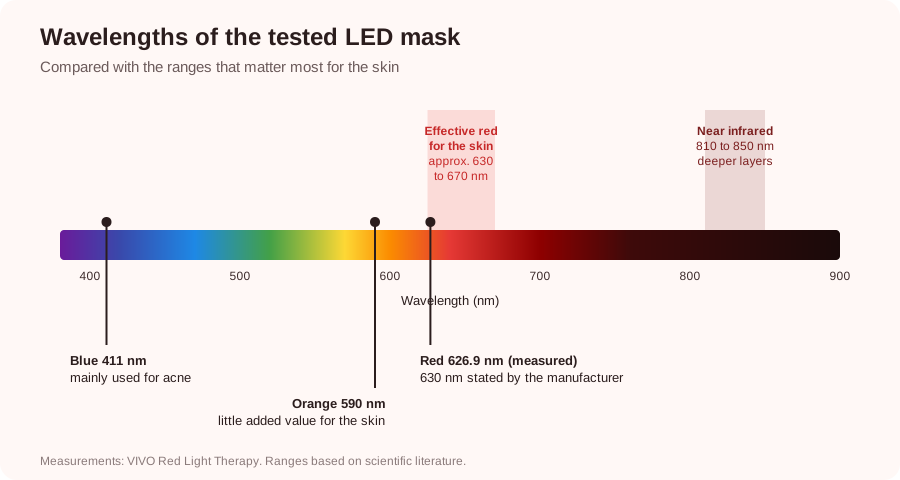
Wavelengths
The stated red wavelength is accurate: 630 nanometres according to the manufacturer, and measured at around 626.9 nanometres. That falls neatly within the effective range for the skin. The mask also contains blue light of around 411 nanometres and orange light of around 590 nanometres.
These aren’t wrong wavelengths. Blue light around 415 nanometres, for example, is used for acne because it targets the bacteria involved. For general skin improvement, such as firmness and fine lines, blue and orange light add little. If you don’t suffer from acne, you’re essentially paying for features you don’t need.
Light intensity
Measured directly at the LED, the intensity comes out at 10 milliwatts per square centimetre (mW/cm²). In practice, the mask doesn’t touch your skin everywhere. In many places there’s one to two centimetres of space in between. Because the LEDs have no lenses to focus the light, the intensity drops quickly with every millimetre of distance.
What does that mean for the dose? Suppose you use the mask for 10 minutes. Where the LED sits directly on your skin, you receive a maximum of 10 × 600 ÷ 1000 = 6 J/cm². That’s fine. But in places with one to two centimetres of distance, the intensity is considerably lower, and so is the dose. Part of your face may then fall below the ideal zone.
Light distribution on the skin
Clear hotspots appear under the LEDs, with weaker zones in between. How pronounced this is depends on your head shape and how the mask sits. Two users, or even two parts of the same face, can therefore receive a completely different light stimulus. In a test with paper at a distance of one centimetre, the separate points of light remained clearly visible. There’s no question of an even light field.
Electromagnetic fields
The electric field is nicely low at 2 volts per metre (V/m). That’s a plus. The magnetic field is a different story: around 26 milligauss (mG) was measured at forehead level. That’s very high for a device you wear directly on your head for extended periods. By comparison, with well designed panels used at a distance, the magnetic field at the usage distance is often close to zero, simply because EMF drops off quickly with distance.
Fit
The mask is on the small side. On a larger head, the face isn’t fully covered. The raised areas around the eyes are clever in theory, as they keep the light a little further from your eyes. In practice, however, this turned out to be one of the least comfortable parts, with a pressing sensation around the eyes.
Flicker
Finally, the flicker of the light was measured. You often can’t see flicker with the naked eye, but your eyes and brain can pick it up. 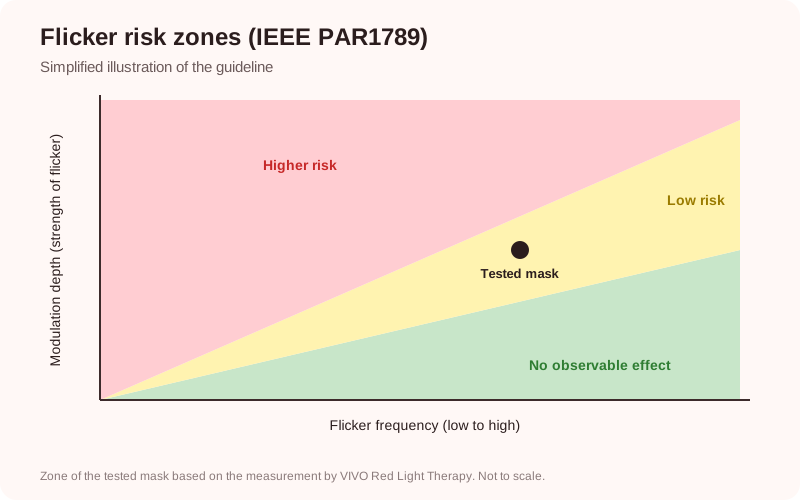 In sensitive people, this can contribute to tired eyes or headaches. The measurement wasn’t extreme, but it wasn’t optimal either. According to the international guideline IEEE PAR1789, the mask falls in the yellow zone. For occasional use that’s acceptable, but for daily and prolonged use, stable light in the green zone is preferred.
Safety: what should you watch out for?
Red light is generally safe, but there are a few points to keep in mind.
Your eyes. Red light isn’t harmful the way UV light is, but bright light very close to your eyes is never ideal. With a mask, the LEDs sit very close to your eyes. Keep your eyes closed during the session or use suitable protective goggles. Blue light deserves extra caution. In 2019, a well known LED acne mask was even withdrawn from the market because of a possible risk to the eyes, especially for people with certain eye conditions.
Light sensitivity. If you take medication that makes you more sensitive to light, such as certain antibiotics or acne treatments, consult your doctor first. The same applies to skin conditions that get worse with light exposure.
Epilepsy and migraine. If you suffer from light triggered epilepsy or migraine, be careful with flickering light and consult a doctor first.
Pregnancy. Little research has been done on red light during pregnancy. If in doubt, check with your midwife or GP.
Tips to get the most out of red light
Whether you choose a mask or a panel, these tips will help you get more out of it:
Start with clean skin. Makeup, sunscreen and thick creams can block or reflect light. So cleanse your face before every session.
Be consistent. Three to five times a week is ideal for most people. Better short sessions you can keep up than long sessions you give up after two weeks.
Stick to the right time and distance. With a panel, you usually work at a distance of 15 to 30 centimetres for the skin, for five to ten minutes. Follow the manufacturer’s guidelines, but also look at the actual measured intensity.
Combine wisely. After your session you can simply apply your serum or day cream. Red light and good skincare reinforce each other.
Take photos. Because results come gradually, you often don’t see them yourself. Take a photo every two weeks in the same light. That way, after a few months, you’ll definitely see the difference.
Checklist before buying a red light device
Ask yourself or the seller these questions:
Which wavelengths does the device use, and have they actually been measured?
How many mW/cm² actually reach your skin, and at what distance was that measured?
What measuring equipment was used? A cheap solar meter often gives unreliable readings for red light, while a spectrometer is much more accurate.
Are EMF values shared, and at what distance?
Is the light free of flicker?
Does the device suit your face, body and routine?
Can you also use it for other parts of your body?
If you can’t get clear answers to these questions, that in itself is a warning sign.
The downside of the hype
With the enormous popularity of LED masks, measuring is no longer a luxury but a necessity. Over the past two years, the market has been flooded with new sellers. Often these are existing products sold under a new brand name, with bold marketing claims and little real knowledge of light therapy.
Measurements are often implied, but concrete values or the equipment used are rarely shared. That makes it hard for you as a consumer to separate marketing from reality. And that applies not just to masks, but to red light devices in general.
At the same time, the market is slowly maturing. Where manufacturers used to boast mainly about theoretical wattages, more and more of them now publish real spectrum measurements and measured light intensity. Looking back through public internet archives, however, you’ll see that this transparency was only added recently by many brands.
That’s exactly why context matters so much. Measurements only mean something when they are taken correctly and applied properly. That things sometimes really go wrong is shown by an example described by VIVO Red Light Therapy: in 2025, the Dutch Advertising Code Committee (Reclame Code Commissie) ruled that a Dutch comparison website for red light therapy was misleading. The site presented itself as independent, while the outcome was in fact determined by the seller itself.
Mask or panel: which suits you?
To keep it simple:
An LED mask suits you if you’re mainly looking for convenience, only want to treat your face and want a device you can use without any setup. Do choose a mask with measured red wavelengths, light free of flicker and a good fit.
A red light panel suits you if you want an even light field, want to control the dose yourself through distance and time, want as little EMF close to your head as possible and also want to use the device for your neck, décolleté, back, muscles or joints.
Conclusion: LED masks in the right perspective
LED masks have undoubtedly contributed to the popularity of red light. They’ve made the subject accessible and served as a first introduction for many people. That deserves some appreciation.
At the same time, practical measurements show where the limits lie: uneven light distribution, a dose that varies by zone, high magnetic fields around the head, limited application and a fit that isn’t comfortable for everyone. On top of that, specifications are often based on assumptions rather than real measurements.
That doesn’t mean an LED mask doesn’t work. It does mean that design, application and measuring method determine how much result you can realistically expect.
With red light, it’s not just about the light itself, but above all about how you apply it. The right wavelengths, a predictable dose, an even light field, low EMF exposure and a form you’ll actually keep using. That combination makes the difference between a fun experience and a well thought out treatment.
That’s why at Dutch Health Store we often recommend a red light panel, which lets you control the distance and dose yourself and can also be used for other parts of your body. We’ll of course keep following new developments, always based on measurements and practical experience.
Not sure what suits you? Feel free to get in touch. I’m happy to help you decide.
Sources
VIVO Red Light Therapy, Michel Peters. LED gezichtsmaskers: Hype of Zinvol voor je Huid? (LED face masks: hype or worthwhile for your skin?). Blog, published 10 January, updated 19 August. Source of the measurement results in this blog.
Wunsch A, Matuschka K. (2014). A controlled trial to determine the efficacy of red and near infrared light treatment in patient satisfaction, reduction of fine lines, wrinkles, skin roughness, and intradermal collagen density increase. Photomedicine and Laser Surgery, 32(2), 93 to 100.
Avci P, et al. (2013). Low level laser (light) therapy (LLLT) in skin: stimulating, healing, restoring. Seminars in Cutaneous Medicine and Surgery, 32(1), 41 to 52.
Huang YY, et al. (2009). Biphasic dose response in low level light therapy. Dose Response, 7(4), 358 to 383.
IEEE Standard 1789 (2015). Recommended practices for modulating current in high brightness LEDs for mitigating health risks to viewers.
Take care of yourself!
With love,
Wilma
 Beauty Products
 Marke A-Z
 Welness
 Gesundheid / Nutrition