
 SHOP
SHOP













 Dutch Health Store Collectie
 English
 Deutsch
 Français
Beauty Tips, Gids & Informatie, Vivo Red Light, Wilma
Elementor #388233

aug
Wilma explains:
FLICKER IN RED LIGHT THERAPY: WHAT YOU NOTICE AND WHICH VALUES ARE GOOD
“Low flicker.”
That phrase shows up regularly in the specifications of red light therapy panels or LED lamps. But a percentage, a concrete value, or a measurement report is often missing.
“No flicker” is basically the same as a car salesman saying a car has “a lot of horsepower.” How much, exactly?
Flicker means that light output does not stay fully constant, but grows stronger and weaker over time. That matters, because research links flicker to eye strain, headaches, migraine, and visual discomfort, among other things. How strongly someone reacts to it depends, among other things, on the size of the modulation, the frequency, the waveform, the brightness, and personal sensitivity.
So it is not enough to read that a light source is “low flicker.” You want to see the actual values. But which values should you actually look at?
SHORT ANSWER
To assess flicker in practice, look mainly at three values:
– Modulation depth or flicker percentage. How much does the light vary?
– The frequency. How often does that happen per second?
– The Flicker Index. How is the variation distributed across the light wave?
And if a waveform is available, you can actually see how the light output behaves over time.
WHAT IS FLICKER?
Light flicker is the rapid, repeated change in a lamp’s light intensity. The light output keeps getting slightly stronger and weaker. Sometimes you see that as visibly blinking light, but the changes can also happen so fast that you do not consciously notice them.
The technical umbrella term for this is temporal light modulation (TLM): a change in light output over time.
In short, a lamp can flicker without you seeing it as blinking with the naked eye. That is why measurements matter, to determine how stable the light output really is.
WHAT CAN YOU NOTICE FROM UNFAVORABLE FLICKER?
Unfavorable light flicker can lead to visual discomfort, tired eyes, difficulty focusing, headaches, and in sensitive people it can trigger or worsen migraine symptoms.
Possible effects include:
– tired or strained eyes
– difficulty focusing
– visual discomfort
– headaches
– triggering or worsening migraine
– fatigue
– a disturbing perception of moving objects
Sensitivity varies a lot from person to person. Where one person can sit under a certain lamp for hours without complaints, someone else can experience eye or head strain much faster. People who are sensitive to migraine or visual load in particular seem to react more strongly to certain forms of temporal light modulation.
CAN FLICKER CAUSE HEADACHES AND EYE STRAIN?
Yes. A classic double blind study from 1989 shows that lighting with strong flicker can go hand in hand with significantly more headaches and eye strain.
Researchers followed office workers under different types of fluorescent lighting. The participants did not know when the lighting in their office was adjusted. Under one type of lighting the light output fluctuated considerably. Under the other, the light was technically driven so that these fluctuations became much smaller and faster.
The result was striking. Under the more stable, high frequency lighting, the average incidence of headaches and eye strain was more than halved. The employees also kept this lighting switched on about 30% longer.
The lamps simply looked lit to the eye, but a more stable light output went hand in hand with clearly fewer complaints.
WHY DOES LED LIGHTING FLICKER?
Part of the poor reputation of LED lighting comes from flicker, and that criticism does not come entirely out of nowhere. LED lighting often lacks a good spectrum, frequently has high EMF radiation, and regularly flickers a lot.
That is because LED reacts extremely fast to changes in electrical current, which means the light output changes rapidly in quick succession.
The driver determines how stable an LED burns
The current from the wall socket cannot go straight to the LED. A power supply and driver first have to convert and regulate it. Think of the driver as the lamp’s current regulator: the more stable the current, the more stable the light output.
With a good driver, LED lighting can have very low flicker. With cheap or poorly designed electronics, the light output can vary strongly and, in extreme cases, move almost fully from on to off.
That also explains why two LED lamps that look nearly identical on the outside can perform completely differently on a technical level.
WHY THE OLD FASHIONED INCANDESCENT BULB GIVES SUCH PLEASANT LIGHT
A classic incandescent bulb makes light in a very simple way: a metal filament gets so hot that it starts to glow. That produces a broad, smooth light spectrum, without the distinct blue peak you see in many white LED lamps. The warm light is therefore often experienced as natural and calm.
That hot filament has another advantage. When the voltage changes briefly, it does not cool down immediately. It keeps glowing for a moment and works as a natural buffer with minimal flicker.
So the incandescent bulb has attractive properties for light quality, but also clear downsides. It uses a lot of energy, produces a lot of heat, has a relatively short lifespan, and offers almost no way to adjust color temperature or light spectrum.
That last point is exactly what makes LED technology interesting, because with LED you can steer and optimize much more, but only if the electronics and the spectrum are well designed.
So LED is not automatically good or bad
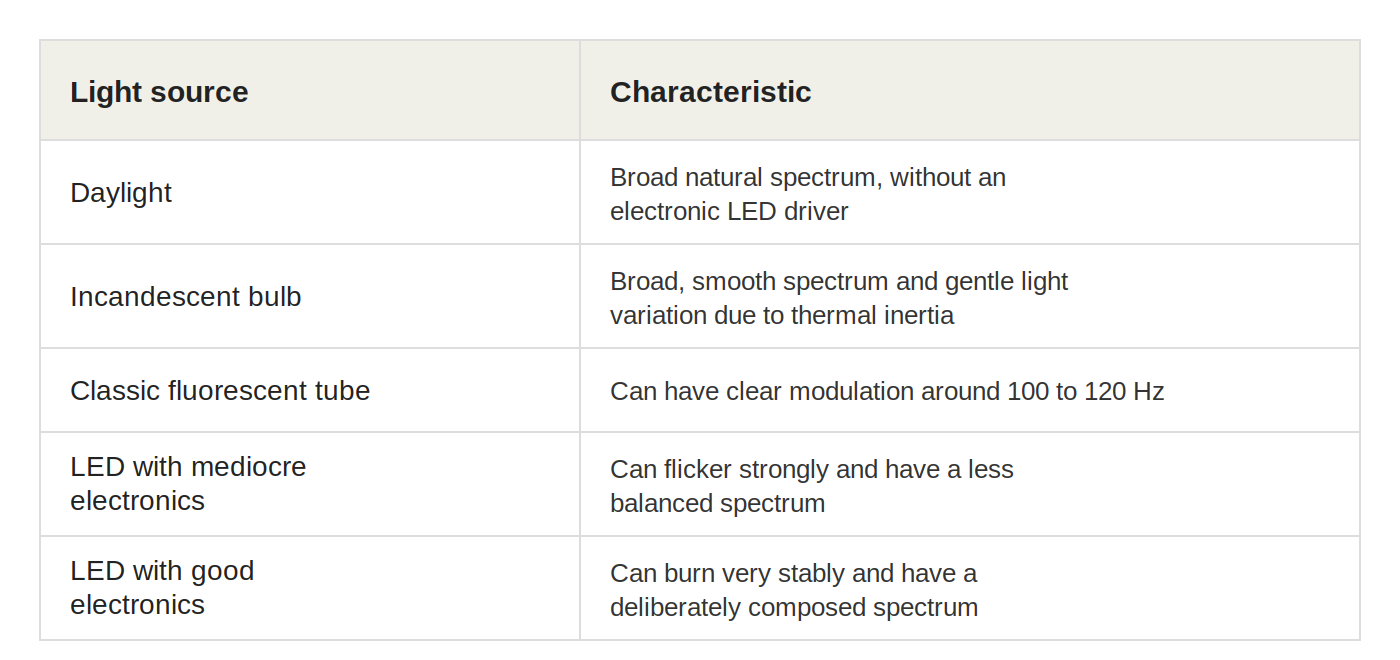
Daylight | Broad natural spectrum, without an electronic LED driver
Incandescent bulb | Broad, smooth spectrum and gentle light variation due to thermal inertia
Classic fluorescent tube | Can have clear modulation around 100 to 120 Hz
LED with mediocre electronics | Can flicker strongly and have a less balanced spectrum
LED with good electronics | Can burn very stably and have a deliberately composed spectrum
LED itself does not automatically determine flicker quality. The combination of LED, driver, and control does.
In short: do not assume LED is good or bad. Measure it, because measuring is knowing.
WHICH MEASUREMENT VALUES ACTUALLY SAY SOMETHING ABOUT FLICKER?
These were already briefly mentioned at the start of this blog. Now let’s go a bit deeper, so you can read a flicker measurement yourself afterwards. Three measurement values are especially practical:
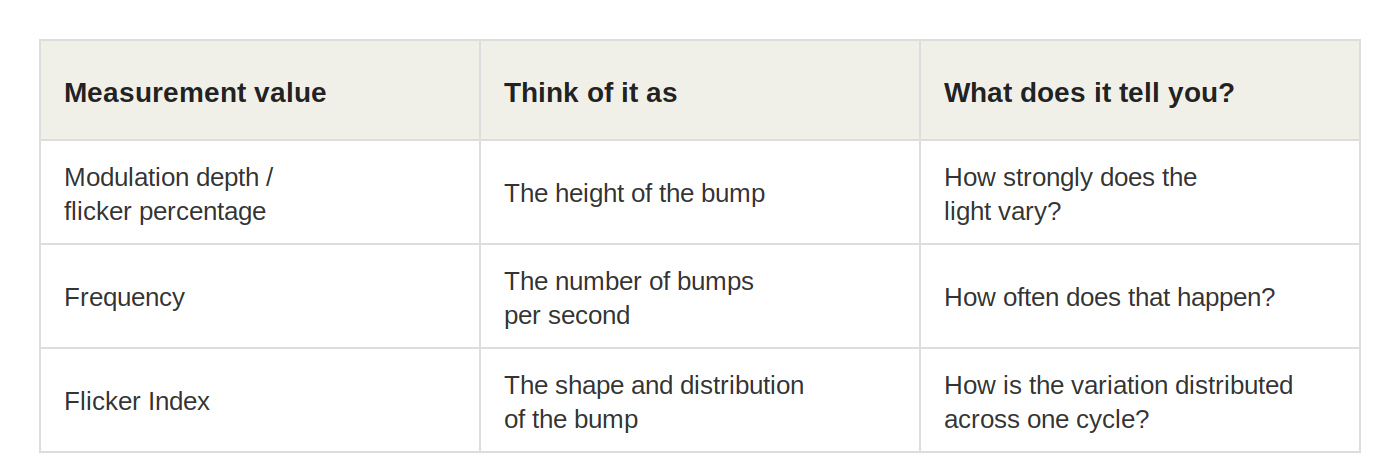
Modulation depth / flicker percentage | The height of the bump | How strongly does the light vary?
Frequency | The number of bumps per second | How often does that happen?
Flicker Index | The shape and distribution of the bump | How is the variation distributed across one cycle?
1. Modulation depth or flicker percentage: how big is the bump?
Modulation depth tells you how big the difference is between the highest and lowest light output. This value is also called percent modulation or flicker percentage and is expressed as a percentage.
Put simply: the higher the percentage, the bigger the swing in light intensity.
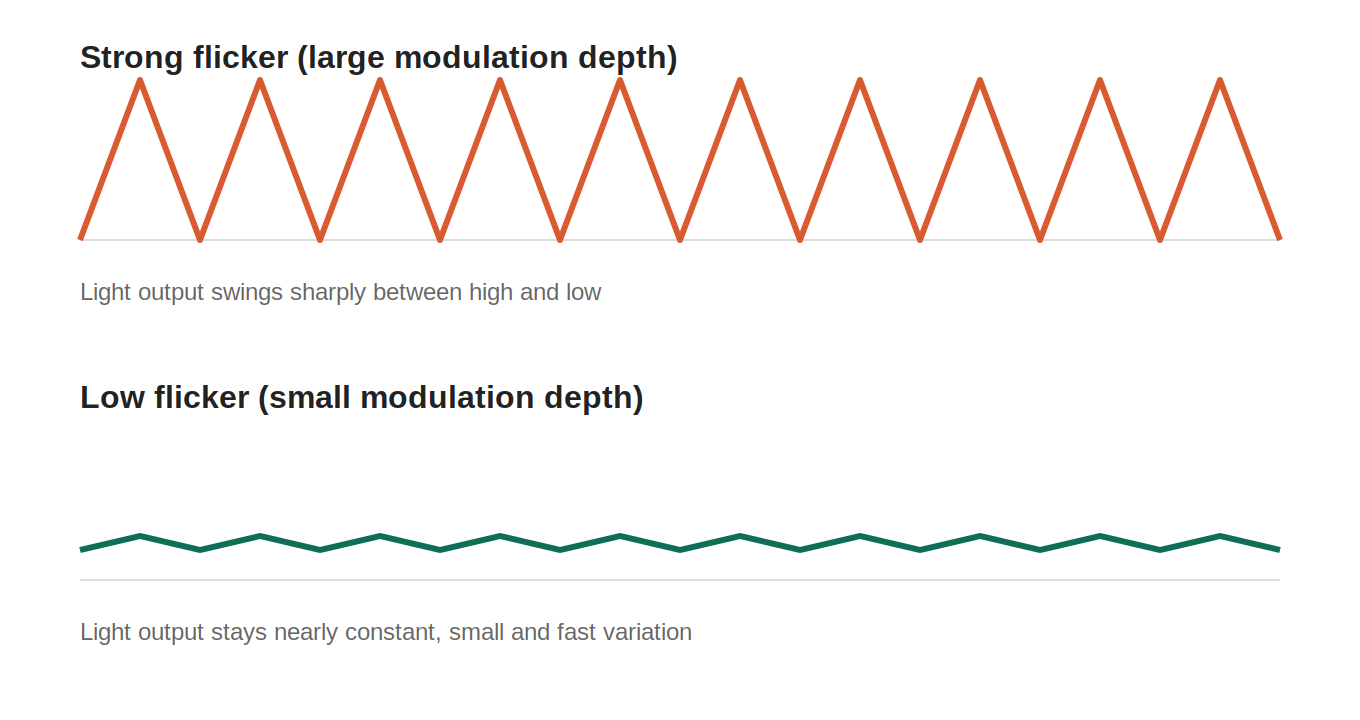
With theoretically fully constant light, the modulation depth is 0%. If a lamp goes fully from maximum light to completely off during every cycle, the modulation depth can reach up to 100%. That is why 1% is very different from 40%, for example. At 40%, the bumps in the light output are simply much bigger.
2. Flicker frequency: how often do the bumps occur?
Frequency tells you how often the light variation repeats per second. This value is expressed in hertz (Hz). So 10 Hz means something repeats 10 times per second, 100 Hz means 100 times per second, 1 kHz means 1,000 times per second, and 40 kHz means 40,000 times per second.
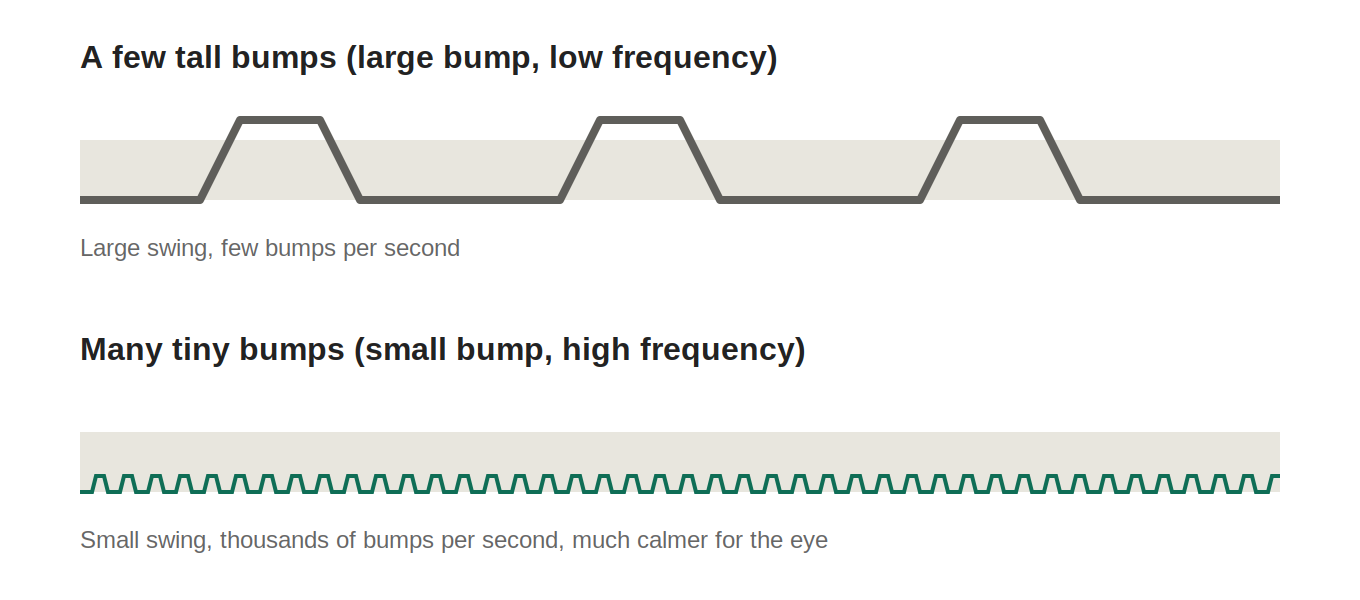
Think again of a road. At a low frequency you encounter a few clear bumps. At a much higher frequency, many small movements follow each other extremely fast, which lets them blend together much more smoothly for our perception. That is why a higher frequency is generally more favorable for reducing directly visible flicker.
But frequency does not tell you how big the bumps are. So a high frequency does not automatically mean a lamp flickers little. A lamp can switch thousands of times per second and still have a large modulation depth at the same time. That is why you always want to look at frequency and flicker percentage together.
3. Flicker Index: how is the bump shaped?
Two light sources can have the same modulation depth and still show a very different course of light output. One wave can rise and fall calmly and gradually. The other can switch much more abruptly.
The Flicker Index gives extra information about how light output is distributed over one cycle. It does not only look at the highest and lowest point.
Think again of two speed bumps. One is wide and rises and falls gradually, while the other is short and sharp. The maximum height can be the same, but the shape is clearly different.
The Flicker Index typically runs from 0 to 1. In measurement reports it is shown as a decimal value, for example 0.0026.
WHAT ARE GOOD FLICKER VALUES?
There is no single number that determines whether flicker is good or bad. What matters most is the combination of how strongly the light varies (flicker percentage) and how often that variation happens per second (frequency). The Flicker Index adds information about how that variation is distributed over a light cycle.
Practical reading guide
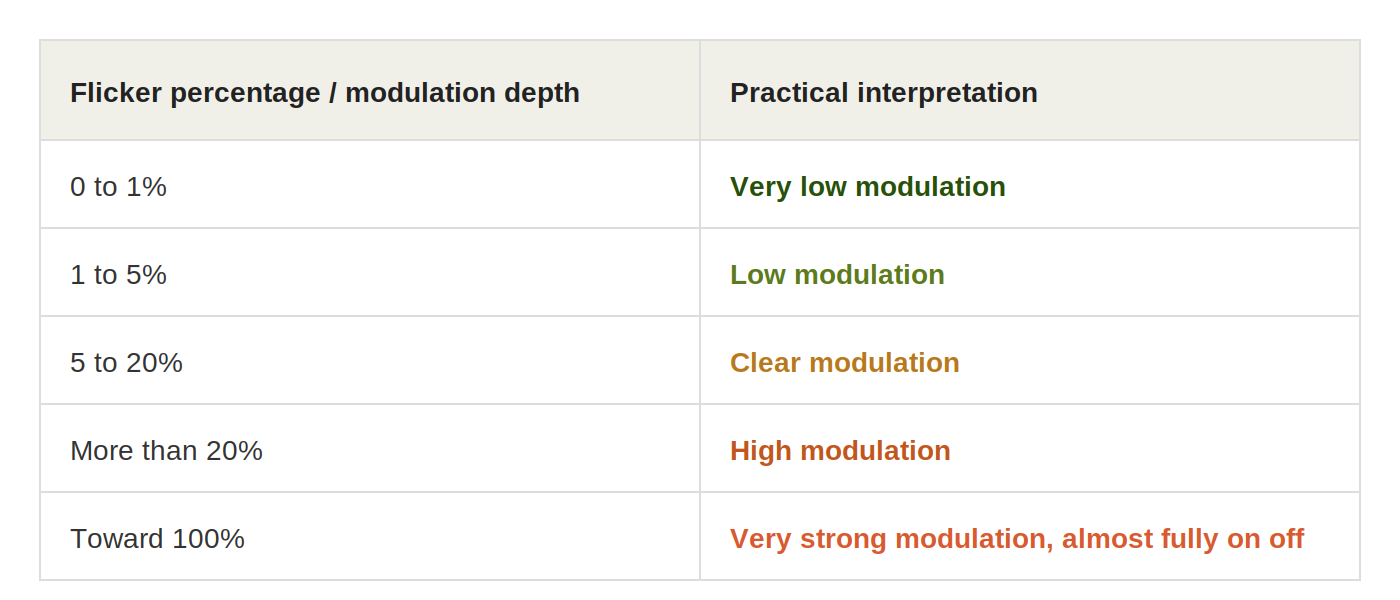
0 to 1% | Very low modulation
1 to 5% | Low modulation
5 to 20% | Clear modulation
More than 20% | High modulation
Toward 100% | Very strong modulation, almost fully on off
The smaller the flicker percentage, the less the light intensity moves up and down. But frequency matters too. Think again of the road: thousands of tiny little bumps are very different from a hundred large speed bumps.
A low flicker percentage combined with a high frequency therefore gives a calmer, healthier light picture, with less chance of unwanted flicker effects. That is why it is better to look at the combination of both when reading a flicker measurement.
AN EXAMPLE: THE VIVO CANDLE BULB
Let’s take a real flicker measurement: the one from the VIVO Candle Bulb. In principle, you can carry out this kind of measurement on any LED light source, from a bedroom lamp and an LED mask to a red light therapy panel.
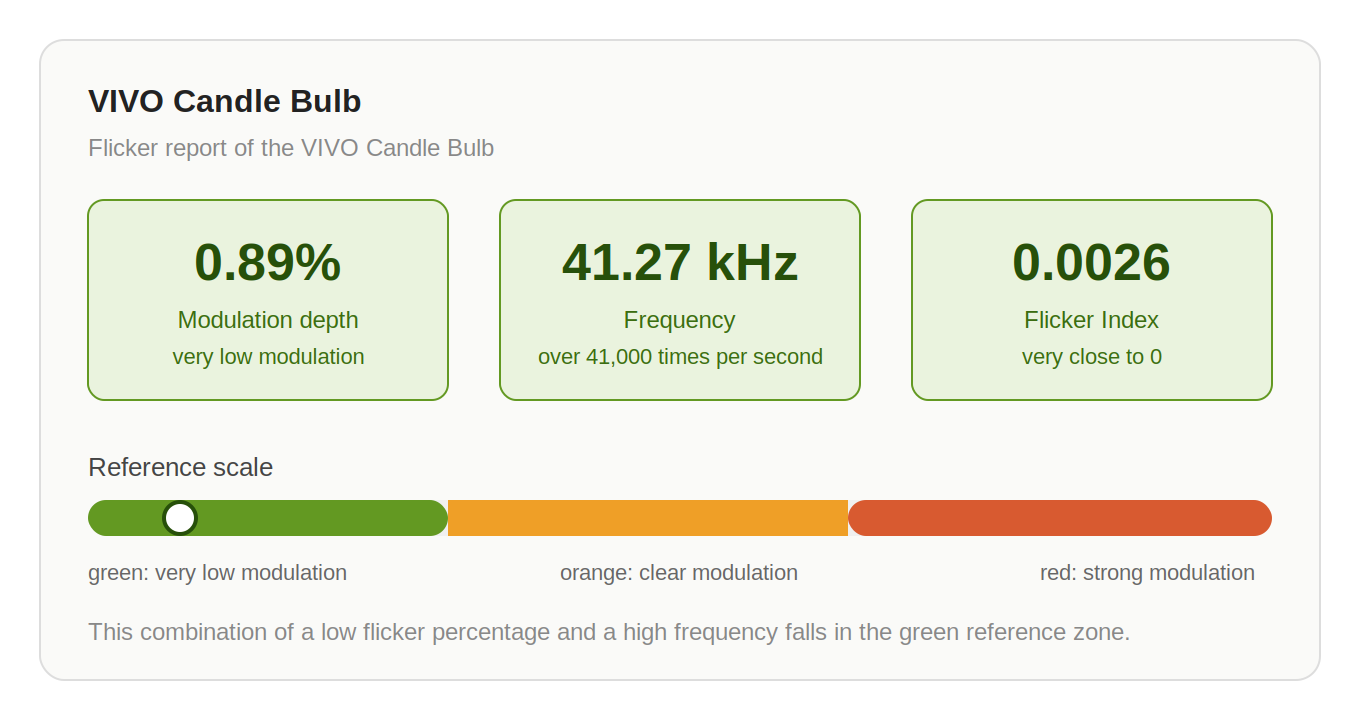
In this example, a flicker percentage of 0.89%, a frequency of 41,270 Hz (41.27 kHz), and a Flicker Index of 0.0026 are measured. What do these values mean?
0.89% flicker percentage. Light intensity varies very little. With less than 1%, this measurement falls into the category of very low modulation.
41.27 kHz frequency. That small variation also repeats itself more than 41,000 times per second. As shown earlier, the combination of a low flicker percentage and a high frequency is favorable.
Flicker Index 0.0026. This value is also very close to 0 and fits a very stable light output.
In plain language: light intensity barely varies, and the small variation that remains happens extremely fast. That is far more informative than simply printing “low flicker” on a package.
WHAT IS THE DIFFERENCE BETWEEN FLICKER AND PULSING?
Flicker and pulsing look similar on a technical level, since in both cases the light output changes over time. The difference lies mainly in the intent.
With flicker, this happens unintentionally, for example due to the power supply or driver. In a continuous light setting, you want to keep these fluctuations as small as possible. With pulsing, the light is deliberately turned on and off in a specific rhythm.
Why do manufacturers use pulsing in red light therapy panels?
Pulsing is regularly presented as an extra therapeutic feature. But for the claim that pulsed red light structurally works better than continuous light, there is no convincing evidence yet.
Studies on pulsed and continuous light show mixed results and also use different frequencies, dosages, and protocols. So pulsing is not automatically a therapeutic advantage.
Still, it is an attractive product feature to advertise. Just like terms such as “more light power means more effect” or “more wavelengths is better,” it sounds logical and sells easily, while the science cannot confirm those claims.
Why does VIVO not use pulsing in large panels?
You use a red light therapy panel from a distance, and it can fill a large part of your field of view. Visible red light that deliberately pulses strongly on and off can then be quite unpleasant, especially for people who are sensitive to flickering light.
Because there is no clear therapeutic added value, the panels are deliberately designed for the most stable possible, continuous light output. That is exactly a property that is valued highly. That is why the measured flicker percentages, frequencies, and Flicker Index of the devices are also published on the certificates and measurement values page.
For the VIVO Red Light Cap and Torch, pulsing is offered as an optional mode. That is a different application, because the Cap sits on the head and the Torch is used against a small area of the body. So there is no large pulsing panel in front of your face.
Pulsing also serves a practical purpose there. During the pulse, a high peak intensity can be used, while average heat build up stays lower because the light is interrupted in between.
In short, pulsing can be technically useful for controlling peak intensity and heat build up, but on its own it is not proof that a red light therapy device works better therapeutically.
FREQUENTLY ASKED QUESTIONS ABOUT FLICKER
What is flicker in lighting?
Flicker is the rapid, repeated change in a lamp’s light intensity. Sometimes you clearly see it as blinking light, but often it happens so fast that you do not consciously notice it. The technical term for this is temporal light modulation.
Can you always see flicker with the naked eye?
No. A lamp can look perfectly calm while the light output still measurably moves up and down. Want to do a quick check yourself? Film the lamp with your phone in slow motion. Strong flicker sometimes suddenly shows up as flickering or dark stripes in the footage. But a phone does not catch everything, especially small or very fast variations can stay out of frame.
What is a good flicker percentage?
The lower the flicker percentage, the smaller the fluctuations in light intensity. At VIVO, 0 to 1% is considered very low modulation and 1 to 5% is considered low. The percentage does need to be looked at together with the frequency, because small, very fast fluctuations are quite different from large, slow ones.
Is a high flicker frequency better?
Generally speaking, a high frequency is favorable, because the changes happen much faster. But a high frequency alone does not say enough. A lamp can still have large differences between light and dark. That is why you always look at frequency and flicker percentage together.
Is LED lighting always bad when it comes to flicker?
A lot of LED lighting is indeed poor when it comes to flicker. With average LED lamps, the focus is often on getting as much light as possible for a low price and low energy use. The quality of the driver and electronics then gets less attention, while that is exactly where strong flicker can arise.
But here is an important distinction: LED does not have to be bad at all. An LED simply reacts very quickly to the current it receives. With cheap electronics, that instability shows up in the light. With a good driver, that same LED can produce very stable light, with a low flicker percentage and high frequency.
So a lot of LED lighting is poorly executed, but that is a quality problem, not an unavoidable trait of LED technology.
Is pulsing the same as flicker?
Technically, light output changes over time in both cases, but the intent is different. Flicker is unwanted variation, for example from the driver. Pulsing is deliberately programmed. Pulsing is sometimes presented as a therapeutic advantage in red light therapy, but there is no convincing evidence that pulsed light structurally works better than continuous light.
Does “flicker free” mean a lamp does not flicker at all?
No. Without measurement values, “flicker free” is mainly a marketing term, and it should be treated more as a red flag than a proof of quality. If a manufacturer has actually measured flicker, they should also be able to state which flicker percentage, which frequency, and which Flicker Index were measured.
Are those figures nowhere to be found? Then ask the manufacturer for the real measurement values, or choose a product where these are published transparently.
CONCLUSION: MEASURING IS KNOWING
With flicker, terms like “low flicker” and “flicker free” say very little on their own. Only real measurement values tell you how stable a light source actually is.
The same goes for claims like “no EMF” or “zero EMF.” There too, it ultimately comes down to the measured value and the distance at which it was measured. Read more here about EMF in red light therapy.
So look mainly at the flicker percentage, the frequency, and the Flicker Index. A well designed LED lamp can produce very stable light. In the end, it is not the label on the package but the technology behind the product that determines the quality.
Check out the certificates and measurement values for the technical measurements of the red light therapy devices.
 Beauty Producten
 Merken van A-Z
 Welzijn
 Gezondheid / Voeding